
Collecting workforce demographic data at the federal level plays an important role in enforcing federal laws prohibiting job discrimination. This explainer provides an overview of the EEO-1 data collection and its uses.
What is EEO-1 Data Collection?
Since 1966, the Equal Employment Opportunity Commission (EEOC), the independent agency tasked with enforcing federal laws banning workplace discrimination, has required certain large private employers to report workforce demographic data to the agency each year. This is known as the “EEO-1 Component 1 Data Collection.” The EEOC conducts separate data collections for unions (EEO-3), state and local governments (EEO-4) and public schools (EEO-5).
What Kind of Data Is Collected?
Private employers subject to Title VII and with 100 or more employeesUnder Executive Order 11246 regulations, certain federal contractors were required to fi le EEO-1 reports with the EEOC. In January 2025, E.O. 11246 was revoked, and the U.S. Department of Labor has proposed rescinding its implementing regulations. are required to provide a demographic breakdown of their workforce over a specific period. This includes full- and part-time workers and remote or teleworking employees.
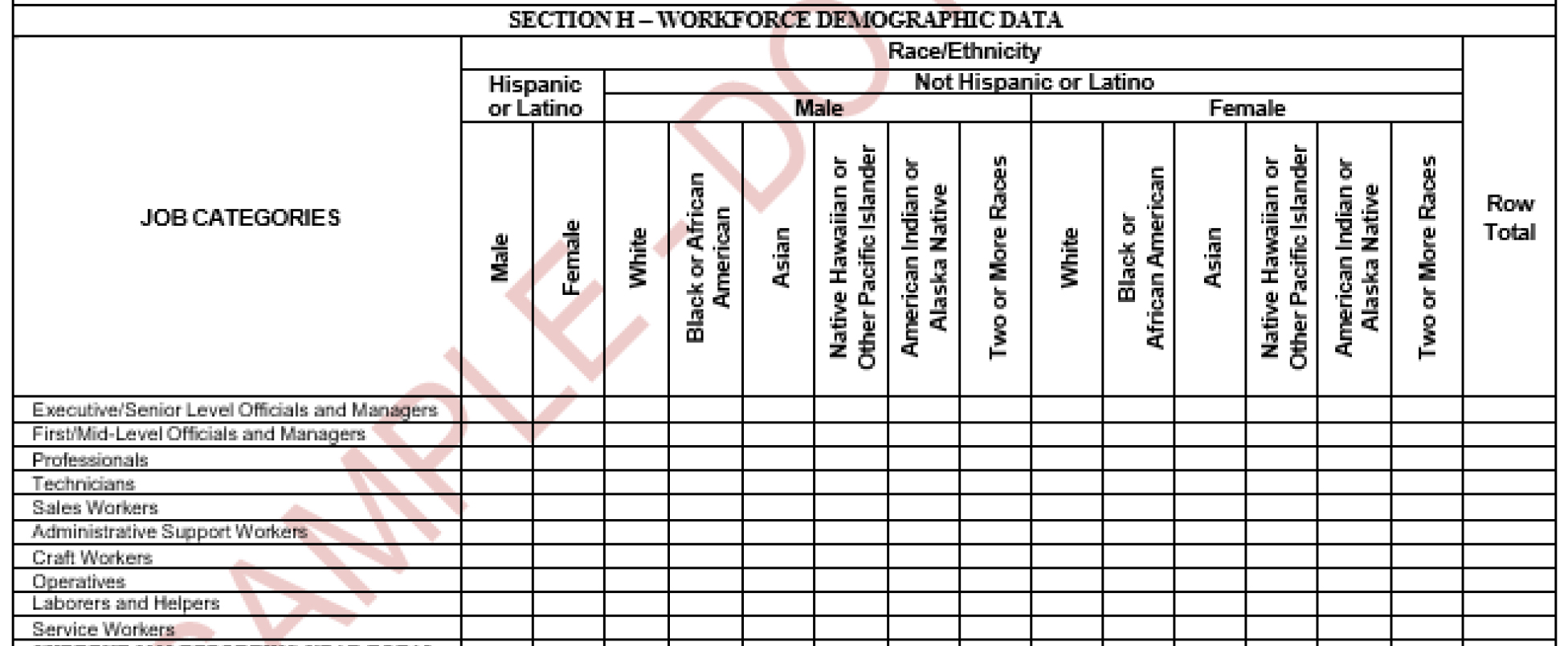
The EEOC has identified 10 job categories, and, for each, employers must provide the number of people they employ by race/ethnicity and sex. For example, employers must provide the number of female, Asian employees who fall into the “Executive/Senior Level Officials and Managers” category.
The 10 job categories are Executive/Senior Level Officials and Managers, First/Mid-Level Officials and Managers, Professionals, Technicians, Sales Workers, Administrative Support Workers, Craft Workers, Operatives, Laborers and Helpers, and Service Workers.
For sex, the data collection allows employers to categorize employees as “male” or “female” for reporting purposes. Previously, employers could voluntarily note “nonbinary” in notes. In 2025, the EEOC eliminated this option.
For race/ethnicity, the data collection asks employers to categorize employees as Hispanic or Latino or Not Hispanic or Latino. Within the “Not Hispanic or Latino” category, employees are then categorized as white, Black or African American, Asian, Native Hawaiian or Other Pacific Islander, American Indian or Alaska Native, and Two or More Races. The EEOC states that offering employees the opportunity to voluntarily self-identify their race and ethnicity is the preferred method for obtaining data for reporting.
Below is a section from a sample report.
Does the EEOC Collect Data on Pay?
The EEOC does not currently collect pay data through the EEO-1 data collection. In 2017 and 2018, the EEOC collected pay data under the EEO-1, Component 2. This collection included information on earnings (collected by pay bands) by race/ethnicity, sex and job category. In 2017, the Trump White House halted collection, but in 2019, a court ordered the agency to collect pay data for 2017 and 2018. In 2019, the EEOC received approval to discontinue further collection of pay data.
A 2023 consensus study from the National Academies affirmed that these data are helpful for the EEOC’s enforcement efforts. Aggregated pay data from previous reports is still available.
The Paycheck Fairness Act would require pay data reporting for large employers.
How Does the EEOC Collect EEO-1 Data?
The EEOC collects EEO-1 Component 1 data through an annual process that requires employers to submit reports through a secure online portal.
Each year, the EEOC announces when the online portal will open and sets the deadline by which employers must submit reports. Dates have varied in recent years:
- In 2025, the collection for 2024 data opened on May 20, with a June 24 deadline.
- In 2024, the collection for 2023 data opened on April 30, with a June 4 deadline.
- In 2023, the collection for 2022 data opened on October 31, with a December 5 deadline. This later date was due to the agency seeking mandatory approval of the collection from the White House (explained below).
The agency also issues an instruction booklet that provides employers with guidance on how to report their data.
How Does the EEOC Use EEO-1 Data?
The EEOC uses EEO-1 data in a few main ways:
- To inform investigations of employment discrimination. The EEOC enforces several federal laws that prohibit discrimination in the workplace. Workers can file charges of discrimination against an employer seeking action from the EEOC. But the EEOC can also open “directed investigations” without receiving a charge. EEOC Commissioners can also initiate charges. Directed investigations and Commissioner charges allow the agency to investigate discrimination when individual employees may not have the information to file a charge. EEO-1 data can help the agency identify unreported patterns of discrimination.
- To help identify where there may be barriers to equal opportunity. Historically, the agency has periodically released reports that use data from the EEO-1 survey and include analysis of workforce demographic trends coupled with charge and litigation data. These reports highlight disparities and potential discriminatory barriers for workers. For example, the agency issued a report finding Black, Hispanic and female workers continue to be substantially underrepresented in the high-tech workforce and noting the need to address barriers.
- To focus the agency’s limited resources. Funding for the EEOC has not meaningfully increased in 45 years, despite a larger workforce, more charges, and new civil rights laws to enforce. Due to limited funding, the EEOC is facing historically low staff levels. Workforce data from EEO-1 reports can help the agency ensure its limited capacity is focused on occupations and industries where data suggests there are barriers to equal opportunity or patterns or discrimination.
- To provide data to the public. The EEOC makes aggregated data associated with 56 million employees and 73,000 employers nationwide available on its website. Notably, this data does not reveal information on individual employers or employees. Section 709(e) of Title VII prohibits any EEOC employee from making individual information from reports public.Executive Order 11246 regulations provided the Office of Federal Contract Compliance Programs with separate authority to collect EEO-1 data for eligible federal contractors. Given this separate authority, some courts have ruled that Title VII’s disclosure prohibitions do not apply. The OFCCP is not subject to privacy restrictions, but disclosure exemptions under the Freedom of Information Act may nonetheless apply. E.O. 11246 was revoked in January 2025.
How is EEO-1 Data Used Outside of the EEOC?
Outside of the EEOC, other entities use EEO-1 data, including –
- State or local agencies that enforce civil rights law. States and local areas often have agencies that enforce their own anti-discrimination laws that may be more or less protective than federal law. Referred to by the EEOC as Fair Employment Practices Agencies (FEPAs), these entities benefit from EEO-1 data for their enforcement efforts. The EEOC provides EEO-1 data to state and local agencies at their request. Information is provided for employers within their jurisdiction, and agencies must agree not to make the information public before starting a proceeding.
- Employers. EEO-1 reports can help employers examine whether there is a significant gap in the demographic makeup of their workforce and the larger labor pool. These gaps may prompt employers to identify hiring or promotion practices that act as barriers to equal employment. This work helps ensure employers are complying with federal anti-discrimination laws, meeting their hiring and workforce goals and building trust with their stakeholders through transparency. Many companies publicly publish their EEO-1 data to, among other reasons, promote transparency.
- Researchers and the Press. Researchers and the press have used EEO-1 data to conduct extensive research and reporting on diversity. For example, Reveal from The Center for Investigative Reporting used EEO-1 reports that were publicly released or released directly to the outlet to examine diversity at Silicon Valley tech companies.
Under What Authority Does the EEOC Collect Workforce Data from Employers?
EEOC’s authority to collect EEO-1 data comes from:
- Statute: Section 709(c) of Title VII of the Civil Rights Act of 1964 requires employers subject to Title VII to make and keep employment records relevant to determining if there has been a violation. The law further requires employers to submit reports from these records, as required by the EEOC through regulation. The law requires a public hearing for these regulations. Where employers fail or refuse to file reports, the statute gives the EEOC authority to go to the courts to order compliance.
- Regulations: EEOC regulations require employers to submit reports, as discussed above, referring to them as “Standard Form 100.”
- Information Collection Approval from the White House: Because the EEOC collects information from ten or more people, the EEO-1 data collection is subject to the Paperwork Reduction Act. This law requires agencies to obtain approval for collection from the Office of Management and Budget (OMB) and to undergo public comment. EEOC normally seeks a three-year clearance. Current approval expires on November 30, 2026.