

The VA Wants To End Coverage of Abortion for U.S. Military Veterans
Associated Press, August 5, 2025
President Donald Trump’s administration is calling to remove abortion coverage from the list of medical benefits for veterans and their families, saying it’s not needed. The Department of Veterans Affairs (VA) posted the proposed rule change on Monday and opened a public comment period on it that runs through Sept. 3. The department said in its proposal that it wants to ensure it “provides only needed medical services to our nation’s heroes and their families.” The department says it would still provide abortion in life-threatening circumstances – something state laws allow, even in places where bans are in place. But critics of the change note that abortion would not be provided when pregnancies are the result of rape or incest. The VA, which provides health coverage for veterans and their dependents, did not include abortion in its coverage until 2022. President Joe Biden’s administration added it months after the U.S. Supreme Court overturned Roe v. Wade and state abortion bans began kicking in. The VA says in its proposal that allowing abortion is legally questionable because Congress has not specifically allowed it. The policy change would also bring the VA’s coverage into line with other federal health care plans – including Medicaid and the TriCare coverage for active military members and their families – which exclude abortion in most cases.

Federal Judges Block Colorado From Enforcing Abortion Pill Reversal Ban, Uphold Abortion ‘Bubble Law’
The Colorado Sun, August 5, 2025
Federal judges in Colorado issued a pair of rulings on state abortion laws last week that could have national consequences, reinforcing the state’s burgeoning status as a battleground over abortion access. First, U.S. District Judge S. Kato Crews upheld a 1993 Colorado law prohibiting activists from approaching people within 100 feet of the entrance of a health care facility to pass them a leaflet, display a sign or engage in “oral protest, education or counseling.” The ban, sometimes called the “bubble law,” was enacted by the legislature as a way to shield women getting an abortion from harassment, though it doesn’t apply just to abortion clinics. Crews wrote July 29 in a summary judgement that since the U.S. Supreme Court already validated the law in a 2000 ruling, the lawsuit challenging the statute, filed by Wendy Faustin, can’t move forward. Separately, U.S. District Judge Daniel D. Domenico ruled Friday that Colorado cannot enforce its 2023 law prohibiting so-called abortion pill reversal against a Catholic health clinic in Englewood. Abortion pill “reversal” is the idea that the effects of the first pill in a medication abortion regimen – a drug called mifepristone – can be counteracted if someone decides not to take the second pill. Providers of “reversal” care try to override this block by flooding patients with high doses of progesterone in the hopes of continuing the pregnancy. The practice is not federally regulated. Colorado can still prohibit other clinics from offering abortion pill reversal.
Jury Finds Meta Liable in Reproductive Health Data Case
Healthcare IT News, August 5, 2025
A California jury has found that Meta violated state privacy laws with its collection of reproductive health data. In the class action suit, Frasco v. Flo Health, Inc., heard in the United States District Court of Northern California, the jury this week said Meta, a named defendant, had violated the California Invasion of Privacy Act when it harvested menstrual data from the Flo Health app, and it intentionally eavesdropped or recorded electronic conversations without consent. “This is a landmark moment in the effort to safeguard digital privacy rights,” said Michael Canty of Labaton Keller Sucharow, the plaintiffs’ legal representation. “Our clients entrusted their most sensitive information to a health app, only to have it exploited by one of the world’s most powerful tech companies,” he reportedly told the Courthouse News Service. Meta legal representative Michele Johnson of Latham & Watkins reportedly told the news service that the plaintiffs agreed to Facebook’s terms of service. But this isn’t the only time Meta has been in court, questioned by lawmakers about its healthcare data collection policies or been caught up in regulatory violations. The Federal Trade Commission fined Facebook $5 billion in 2019 for failing to comply with a 2012 agreement with the regulator to protect users’ data, according to a story from Reuters earlier this month, and the European Union said Meta violated EU privacy regulations. The tech company has a now lengthy history of being caught up in data privacy scandals and health data privacy lawsuits after political consulting firm Cambridge Analytica was found to be using breached consumer Facebook data to inform client campaigns, including the 2016 presidential campaign of then-candidate Donald Trump.
Tennessee Demands Abortion Data From Hospitals in Ban Exceptions Case
The Guardian, August 6, 2025
The Tennessee attorney general’s office has subpoenaed four medical groups in the state for records of abortions performed over the last several years as part of a lawsuit over the exceptions to the state’s near-total abortion ban, court documents obtained by The Guardian show. The four subpoenas were issued this spring to Vanderbilt University medical center and a Tennessee hospital run by the national Catholic chain Ascension, as well as two smaller medical practices in Tennessee, Heritage Medical Associates and the Women’s Group of Franklin. Although each subpoena is different, they broadly ask these organizations to turn over extensive information about instances in which they may have provided abortions, including the number of abortions performed since 2022 and, in some of the subpoenas, all “documents and communications” related to those abortions. When and if the medical providers turn in the records, they are legally allowed to preserve “all patient confidentiality as necessary”, according to the subpoenas. A protective order has also been issued to block the records from being used to investigate the hospitals and medical providers outside of the scope of the lawsuit, as well as to potentially mark even the anonymized patient records as “confidential.” The sweeping requests raise questions about red-state attempts to track abortion providers in a post-Roe v. Wade U.S. In the three years since the US supreme court overturned Roe, reproductive rights activists have grown increasingly concerned about government efforts to collect information on abortions, especially as states such as Louisiana and Texas have recently launched efforts to penalize abortion providers.
How Anti-Abortion and Anti-Trans Bills Are Impacted by Texas Democrats Fleeing the State
The 19th, August 4, 2025
Texas Democrats fled the state over the weekend to stop a Republican proposal redrawing the state’s congressional maps. But their exit has also temporarily halted other conservative priorities for the special session – including new abortion restrictions and a “bathroom bill” that would ban transgender people from using public restrooms that match their gender. When Democratic members of the Texas House of Representatives left the state this weekend, it denied lawmakers the two-thirds quorum needed to proceed with legislative work. That move came after a House committee voted to approve the new congressional maps, a plan – crafted on President Donald Trump’s request – that would likely flip five Democratic seats to favor Republicans. Although the redistricting effort has taken center stage in the ongoing special legislative session, Abbott tasked lawmakers with a host of other priorities. Time may be running out: The special session began July 21, and ends after no more than 30 days. Already, some are considering the possibility of lawmakers returning to the capital for a second special session to tackle now derailed items like further abortion restrictions and the anti-trans bill. Following pressure from state and national anti-abortion activists, Abbott asked for legislation that would have let private citizens sue health providers for mailing or prescribing abortion medication to patients in Texas – an effort to block health care from groups like Aid Access, an organization through which medical professionals in other states prescribe and mail abortion pills to people living under bans. A similar proposal failed to make it in time to the House floor in the final days of the state’s regular lawmaking session earlier this year.
ICYMI: In Case You Missed It
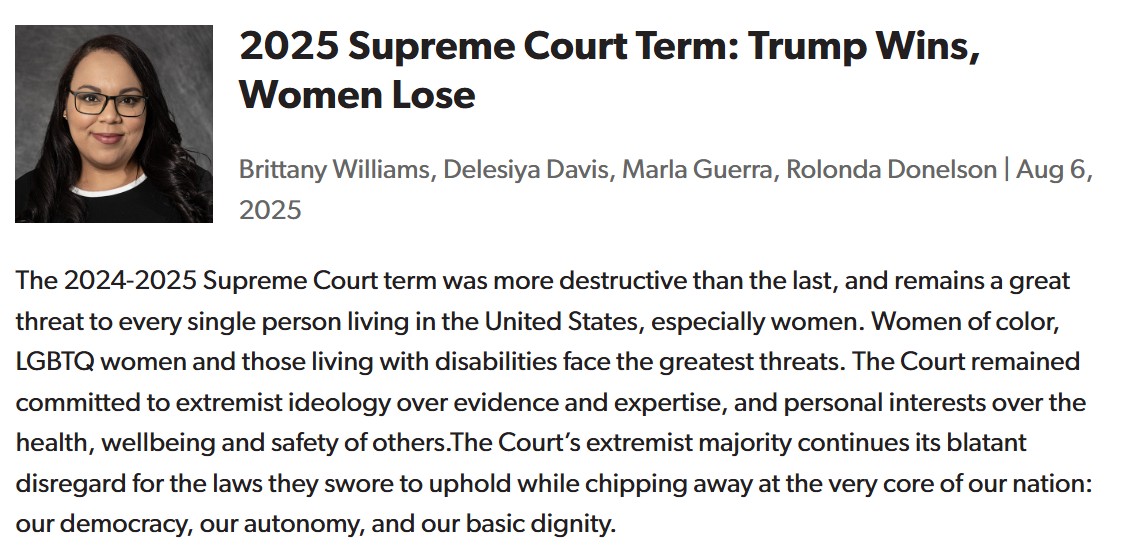
This Supreme Court Term was a great betrayal of women and families.
We respect your privacy. Read our policy.
Note: The information contained in this publication reflects media coverage of women’s health issues and does not necessarily reflect the views of the National Partnership for Women & Families.