U.S. Judge Blocks Trump Religious Exemption to Birth Control Coverage
Reuters, August 13, 2025
A U.S. judge on Wednesday struck down rules adopted during President Donald Trump’s first term that exempt employers with religious or moral objections from having to provide workers with insurance coverage for birth control. U.S. District Judge Wendy Beetlestone in Philadelphia said the 2018 rules were not justified, rejecting the Trump administration’s claims that they were necessary to protect the rights of religious employers. The ruling came in a lawsuit by Pennsylvania and New Jersey that reached the U.S. Supreme Court, which in 2020 upheld the rules on technical grounds but did not address their merits. The federal Affordable Care Act requires employers to provide insurance coverage for contraception but allows those with religious objections to seek exemptions. The 2018 rules created a blanket exemption for employers with religious or moral objections to contraception. The Trump administration said that even requiring employers to apply for an exemption could burden their religious practice, in violation of federal law. But Beetlestone on Wednesday said there was a mismatch between the vast scope of the exemption and the relatively small number of employers who may need it.

Medication Abortion Drove Up Number of U.S. Procedures After Roe’s Repeal, Study Shows
The Guardian, August 11, 2025
An abortion provider shipped almost 120,000 packs of abortion pills to U.S. residents between July 2023 and August 2024 – nearly 100,000 of whom lived in states that outlaw the procedure or have laws on the books that ban the mailing of abortion pills, according to a new study published in the prestigious medical journal Jama on Monday. U.S. abortion providers performed 1.14m abortions in 2024 – the highest number on record in recent years, according to data from #WeCount, a Society of Family Planning project. By the end of the year, #WeCount found, a full quarter of all abortions were being facilitated through telehealth. This study, which was led by a University of Texas at Austin professor and studied shipments from the telemedicine abortion service Aid Access, more fully fleshes out the portrait of U.S. abortion access, as it is the first to examine abortion pill provision at the county level. The poorer a county was, the more likely its residents were to order abortion pills, researchers discovered. Counties where the poverty rates hovered between 10% and 20% had provision rates that were 1.63 times higher than counties where the poverty rate was lower than 5%. In counties where the poverty rate was above 20%, the provision rate was 1.93 times higher than in richer counties. Abortion pill provision rates were also more than three times higher in states that ban abortion compared with those that do not. In states that specifically ban telemedicine abortion, the provision rates were more than twice as high. Counties that were located farther from abortion clinics were also likely to see higher rates of abortion provision.
Trump Has Said Abortion Is a State Issue. His Judicial Picks Could Shape It Nationally for Decades
Associated Press, August 10, 2025
One called abortion a “barbaric practice.” Another referred to himself as a “zealot” for the anti-abortion movement. Several have played prominent roles in defending their state’s abortion restrictions in court and in cases that have had national impact, including on access to medication abortion. As President Donald Trump pushes the Senate to confirm his federal judicial nominees, a review by the Associated Press shows that roughly half of them have revealed anti-abortion views, been associated with anti-abortion groups or defended abortion restrictions. Trump has offered shifting positions on the issue while indicating he wants to leave questions of abortion access to the states. But his court nominees will have lifetime appointments and be in position to roll back abortion access long after the Republican president leaves the White House. Bernadette Meyler, a professor of constitutional law at Stanford University, said judicial nominations “are a way of federally shaping the abortion question without going through Congress or making a big, explicit statement.” Of the 17 judicial nominees so far in Trump’s second term, at least eight have argued in favor of abortion restrictions or against expanded abortion access. No such records could be found for the other nine, nor did the AP review find evidence that any of Trump’s judicial nominees support increased access to abortion. Trump’s first term also had an enduring impact on the courts, appointing 234 judges. By the end of that term, more than one-quarter of active federal judges were nominated by Trump, including three Supreme Court justices who helped overturn Roe v. Wade.
Missouri AG Erred in Asking Supreme Court To Overturn Order Legalizing Abortion
Missouri Independent, August 12, 2025
The Missouri Supreme Court on Tuesday refused to take up Attorney General Andrew Bailey’s request to reinstate restrictions on abortion in the state, ordering him to turn to a state appeals court instead. Bailey was hoping the state’s highest court would block a temporary injunction issued by Jackson County Circuit Judge Jerri Zhang on July 3 that allowed surgical abortions to resume in Missouri. Zhang’s injunction pointed to the constitutional amendment approved by Missouri voters last year enshrining the right to an abortion in the state constitution. The attorney general contends Zhang abused her discretion in issuing the injunction. In a 7-0 ruling Tuesday, the Supreme Court said Bailey should not have skipped the court of appeals in his quest to overturn Zhang’s order. The current fight over abortion rights has been a state question since 2022, when the U.S. Supreme Court overturned the landmark 1973 Roe v. Wade decision. The decision triggered a law that banned all abortions in the state except in cases of medical emergency that endangered a woman’s life. In response, voters last year approved Amendment 3, legalizing abortion up until the point of fetal viability. But because the amendment did not directly repeal state laws banning or regulating abortion, Comprehensive Health of Planned Parenthood Great Plains, based in Kansas City, and Planned Parenthood Great Rivers, based in St. Louis, sued to block enforcement of those laws.
Appeals Court Upholds Indiana Abortion Ban
Indiana Capital Chronicle, August 11, 2025
The Indiana Court of Appeals on Monday affirmed a ruling by a trial court judge upholding the state’s near-total abortion ban, specifically provisions relating to medical providers and potential exemptions. The law, which was enacted in a special 2022 session, only allows for exceptions in the case of a mother’s health, rape or incest, or a fatal fetal anomaly – though each with varying time limits. Plaintiffs argued that certain pregnancies could imperil the health of the mother, but providers could be afraid to pursue an abortion for fear of the repercussions. Additionally, the law limits all abortion care to hospitals or an ambulatory surgical center, rather than the free-standing clinics who largely performed these reproductive health procedures prior to the ban. The underlying abortion case initially centered on the risk to the health of the mother and the rights of providers, delaying the implementation of Indiana’s ban by roughly one year. After an Indiana Supreme Court ruling in favor of the state’s ban – though left the door open for future challenges – plaintiffs, represented by the American Civil Liberties Union of Indiana, amended their complaint to narrow their focus.
ICYMI: In Case You Missed It
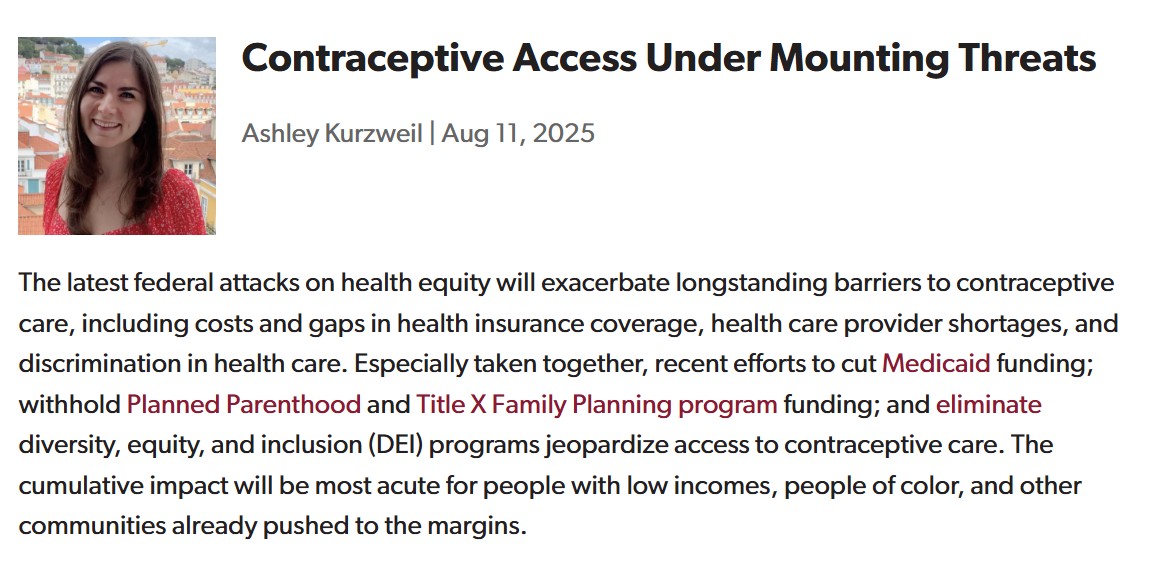
Issues of contraceptive affordability, challenges securing coverage, and the prescription requirement for many methods hold far too many people back from getting contraceptive care.
We respect your privacy. Read our policy.
Note: The information contained in this publication reflects media coverage of women’s health issues and does not necessarily reflect the views of the National Partnership for Women & Families.