
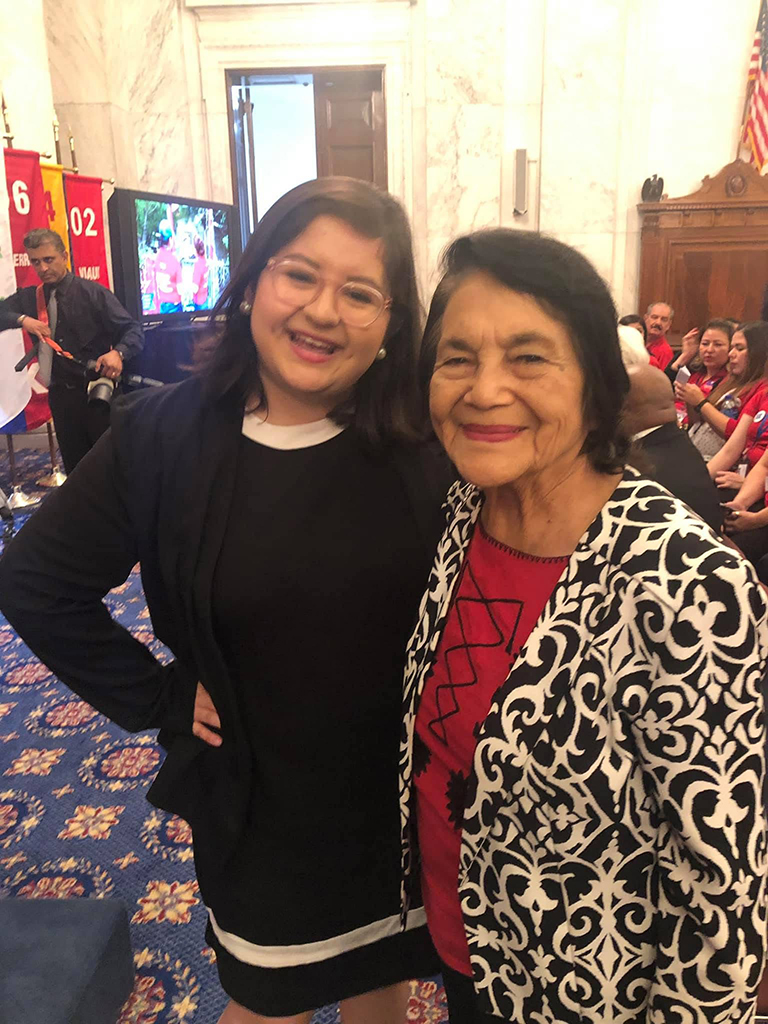
It’s not every day that the Senate’s Kennedy Caucus Room is packed with Latinos. But there we were, gathered in a massive, regal chamber unlike any place I’d seen, with Dolores Huerta front and center.
I was 21 years old, fresh out of college and coordinating my first major work event, the 2019 Robert F. Kennedy Human Rights Award ceremony. Dolores was the keynote speaker, helping us honor grassroots immigrant rights groups from Texas. As a Latina from South Texas, that day was particularly meaningful to me and I was honored to join forces with a movement elder.
At the time, Dolores was 90 years old – a spry 90, I might add. She moved through the halls of Congress with familiarity and purpose, fired up and ready for anything. I was surprised by how fast I had to walk to keep up with her.
Dolores looked around the chamber, smiled, and said that the Kennedys had always brought people like us in through the front door and not the back door. She delivered a powerful address, leading hundreds of organizers and advocates from near and far in her signature chant of “sí se puede” (yes, we can). Watching her speak, I couldn’t help but notice how quickly she had transformed the energy in the room. Yes, we can use this chamber to uplift immigrant voices and stories. Yes, we can show everyone that Latinos belong in a place like this.
That’s what Dolores taught me: that we could claim space for the Latino community, and for Latinas in particular, in places that weren’t traditionally meant for us.
In the late 1950s, Dolores began advocating for school children before the predominantly white, male California legislature. In 1962, she co-founded the National Farm Workers Association, which later became United Farm Workers, serving as the only woman on the executive board. She took up space at the bargaining table, negotiating the first contract in history between farmer workers and growers. As a union leader, she challenged machismo in the Latino community and worked to bring more women into leadership roles within the union.
Dolores saw the dignity, beauty, and worth in Latina workers everywhere, even when so many leaders and institutions did not. My grandmother and her siblings were farm workers, part of a longstanding history of agricultural labor in our country that continues across many generations of Latino families today. Dolores understood that farm workers were more than their labor. She fought for a future where some of the most exploited workers in the country could be protected from harmful pesticides, access basic necessities like toilets and water, and earn better wages and health benefits.
To see the same twinkle in Dolores’ eyes at 90 – that I can only imagine was there in her youth – tells me that her passion ran deeper than any responsibility tied to a title or job. That kind of fire can only come from one place: a genuine love for people and a lifelong commitment to building a better world for others.
The loss of Dolores Huerta is painful, especially at a time when democracy and hard-won civil rights are under attack. But her life taught me that the work of fighting against injustice and claiming space for our communities has never been easy or convenient. It has, however, always been necessary, and it’s work we must continue doing together.