
By Tori Coan and Taryn Williams
Disabled women are doing more with less.A part of the disability community has reclaimed identity-first language (i.e., “disabled”) to acknowledge disability as a critical part of identity in which to take pride. However, not all members of the disability community prefer identity-first language. Others may prefer person-first language (i.e., “person with a disability”). This brief uses identity-first and person-first language interchangeably. However, the Partnership will always honor the language a disabled person chooses for themselves. There are also several definitions of disability; no one definition or model is perfect. The Americans with Disabilities Act (ADA), for example, defines disability as “(A) a physical or mental impairment that substantially limits one or more major life activities of such individual; (B) a record of such an impairment; or (C) being regarded as having such an impairment.” 42 U.S.C. § 12102. Major life activities also include major bodily functions. 42 U.S.C. § 12102(2)(B). This definition is quite broad. Different models of disability also affect the ways disability is defined and viewed. Disabled World. (2026, July 9). Models of Disability: Types and Definitions. Retrieved 14 July 2026. As the affordability crisis squeezes family budgets across the country, and federal policymakers roll back equity and inclusion initiatives, disabled women – particularly disabled women of color – face deeply-entrenched barriers to economic stability and security. For working disabled women, one of these barriers is being paid less than nondisabled men.
- In 2024, disabled women workers, including those working part-time and seasonally, were paid 56 cents for every dollar paid to nondisabled men – $24,000 less per year.*
- Among full-time, year-round workers, this figure is 68 cents, resulting in $21,500 less per year.*
Doing More with Less: Causes and Consequences of the Wage Gap
Despite record employment rates, disabled women remain significantly less likely to be in the labor force than nondisabled men. In addition to lower wages, disabled women are often “last hired, first fired,” experiencing higher rates of job loss and slower rates of job re-entry than nondisabled workers. These disparities reflect persistent barriers and discrimination in education, housing and labor markets, which contribute to the occupational segregation of disabled women into low-wage, part-time jobs. These jobs are less likely to offer benefits like paid family and medical leave, putting disabled women at a further disadvantage to balance employment, caregiving responsibilities and their own health care needs.
Barriers to workplace accommodations, like telework and flex scheduling, contribute to the wage gap by making it harder for disabled women to enter and remain in the workforce. Similarly, the abdication of federal oversight and investment in workforce and education support programs limit pathways into education and employment. At the same time, cuts to Supplemental Nutrition Assistance Program (SNAP), Medicaid, Supplemental Security Income (SSI) and health care subsidies limit sources of income, food, health and personal care for disabled women and their families.
Millions of disabled adults are managing work and care obligations with fewer resources than their nondisabled peers. For example, 58 percent of disabled adults are the heads of their household, and more than 4 million parents in the U.S. are disabled. Almost a quarter (24 percent) of disabled adults are family caregivers, compared to only 19 percent of nondisabled adults. When disabled women are paid less, the people they care for and communities they live and work in suffer.
The impacts of lost earnings are heightened for disabled women, particularly women of color, who have less wealth and fewer resources to fall back on than white disabled and nondisabled women. Lost earnings and less wealth matter because people with disabilities must spend more of their income to achieve the same quality of life as nondisabled people. These additional costs, known as the “crip tax” or “disability squeeze,” include things like medical care, assistive technology, personal care attendants and other items and services needed for full participation in daily life. Eighty-three percent of working disabled adults had at least one disability-related out-of-pocket cost in 2023, requiring an average 10 percent of their annual income, and women typically incur higher disability-related costs than men.
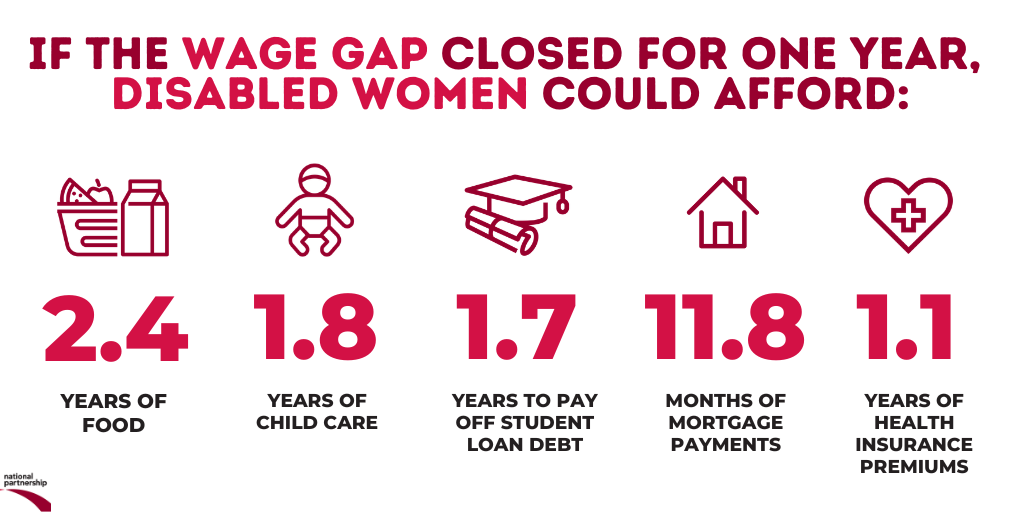
If disabled women did not lose $24,000 to the wage gap, they could afford one of the following:*
- Nearly two years of child care.
- Two years of tuition and fees at a four-year college, or three times the full cost of tuition and fees at a two-year college.
- Nearly two and a half years of food.
- More than one year of premiums for employer-based health insurance.
- More than one year of monthly rent and utility costs.
- Nearly one year of mortgage payments.
- To pay off their student loan debt in less than two years.
- Four and a half years of disability-related expenses.
Disaggregating the Wage Gap
Disabled women are not a monolith. Examining the wage gap across demographic groups offers a more in-depth understanding of the barriers disabled women face in the labor market. Unless explicitly stated, wage estimates in this report are for all workers, including those who work part time and/or seasonally.
Race/Ethnicity*
The wage gap for disabled women varies by race and ethnicity. For every dollar paid to a white nondisabled man:
- Disabled Latinas are paid 46 cents.
- Multiracial disabled women are paid 47 cents.
- Black, American Indian and Alaska Native (AIAN) and white disabled women are paid 50 cents.
- Asian American, Native Hawaiian and Pacific Islander (AANHPI) disabled women are paid 55 cents.
Working full time offers disabled women minimal progress towards equal pay with nondisabled men and exposes further gaps between white disabled women and disabled women of color. Wage gaps among full-time, year-round workers are especially large for many disabled women of color, showcasing the interlocking effects of racism, ableism and sexism in the labor market. For every dollar paid to a white nondisabled man working full time, year round:
- Disabled Latinas are paid 53 cents.
- Black disabled women are paid 57 cents.
- AIAN and multiracial disabled women are paid 60 cents.
- White disabled women are paid 64 cents.
- AANHPI disabled women are paid 73 cents.
Education*
Disabled women with a high school degree or less experience the largest gender wage gap: they are typically paid just 52 cents for every dollar paid to nondisabled men with the same educational attainment. While the wage gap is smallest for disabled women workers with a bachelor’s degree (57 cents on the dollar when compared with nondisabled men with bachelor’s degrees); they are typically paid $500 less per year than nondisabled men with a high school degree. Among full-time, year-round workers, wage gaps become larger as educational attainment increases.
Motherhood*
Disabled mothers face a larger wage gap than disabled women overall: they are typically paid only 44 cents for every dollar paid to nondisabled fathers. In contrast, nondisabled mothers are paid 63 cents on the dollar compared to nondisabled fathers. This is because nondisabled fathers are typically paid more ($72,000) than nondisabled men overall ($54,000), and because disabled mothers typically are paid less ($32,000) than nondisabled mothers ($45,500).
Age*
Wage gaps between working disabled women and nondisabled men are larger for older women, mirroring the pattern seen for women overall. While young disabled women workers (ages 16-24) have the smallest wage gap, they are still typically paid only 69 cents on the dollar compared to nondisabled men of the same age. For each age group 35 and older, disabled women are typically paid roughly half of what their nondisabled men are paid.
Living Arrangements*
Disabled women living in group quarters, like nursing homes or group living facilities, are typically paid very low wages ($11,500 per year). This is, in part, because federal law allows certain employers to pay disabled workers less than the minimum wage, affecting more than 38,500 disabled workers in 2024. The majority of these workers make less than $3.50 per hour in community rehabilitation programs, like sheltered workshops, which segregate disabled employees from their nondisabled peers. Barriers to competitive integrated employment (CIE) exacerbate exclusion and the wage gap for disabled workers. CIE refers to when disabled employees work alongside nondisabled employees with comparable pay, benefits and opportunities for advancement to their nondisabled peers.
Region*
Disabled women workers are typically paid 50 cents per dollar paid to nondisabled men in Northeastern states, 51 cents in Midwestern states, 54 cents in Western states and 59 cents in Southern states. Disparate wage gaps across regions are due, in part, to differences in where disabled people live and work and differences in regional economies and state policy landscapes.
Veterans*
Disabled women veterans experience a smaller wage gap than disabled women overall: they are typically paid 66 cents for every dollar paid to nondisabled male veterans. Higher wages among disabled women veterans may be the result of the positive effects of veteran status in hiring and the impact of targeted employment programs for veterans, as well as the strong representation of veterans in the public sector, which tends to have smaller wage gaps.
Gender Identity and Sexual Orientation
Disabled adults are nearly twice as likely to identify as LGTBQ+ than nondisabled adults (13 percent compared to 7 percent). Disabled LGBTQ+ adults face overlapping ableism and anti-LGBTQ+ discrimination. They report experiencing more economic insecurity and workplace discrimination – including being denied equal pay – compared to their nondisabled, non-LGBTQ+ peers. Available research suggests much lower rates of full-time employment among LGBTQ+ disabled women compared to their nondisabled peers. Lack of federal data collection prevents us from disaggregating reliable wage data for disabled LGBTQ+ workers and for specific groups within the LGBTQ+ community.
Disability Type*
Women with all types of disabilities face wage gaps. Working women who report difficulty with independent living experience the largest wage gap: they are typically paid only 39 cents per dollar paid to nondisabled men. Working women with hearing disabilities experience the narrowest wage gap, typically paid 61 cents per dollar paid to nondisabled men.
Economic Security Beyond the Wage Gap
All disabled women deserve more, regardless of whether they are employed. Achieving economic justice means addressing ableist policy barriers that disincentivize employment and confine disabled women to poverty. The $2,000 asset limit for SSI benefits penalizes disabled women, regardless of employment status, by making it incredibly difficult to save money and invest in education, family and the local economy. Remaining below SSI income and asset limits can save the lives of disabled people while eroding their standard of living. In the case of Social Security Disability Insurance (SSDI), disabled women are less likely to qualify, and receive lower benefits on average, than men because benefits depend on formal employment history and wage levels. Disabled women are more likely to take time out of work for personal or family care needs and less likely to work in jobs that count towards SSDI work history than men. While working disabled women deserve equitable treatment and pay, we cannot leave disabled women who cannot or choose not to work behind.
Systemic and Policy Changes Are Needed to Support Disabled Women
Closing the wage gap and achieving economic security for disabled women requires a multi-pronged approach. Policymakers must recognize that disabled women’s equity and full inclusion in employment depends on civil rights protections, access to community-based services, and affordability policies that address additional costs associated with disability.
Enforce Civil Rights and Inclusion in Employment
To close the wage gap, disabled women must have equitable access to workforce preparation, employment and fair pay. Achieving these goals requires strong civil rights enforcement, accurate data collection and policies that improve job quality.
Congress should:
- Strengthen equal pay protections. Pass the Paycheck Fairness Act to improve pay transparency and provide the data needed to address wage gaps due to discrimination.
- Raise the minimum wage and eliminate the subminimum wage. Pass the Raise the Wage Act and support the transition to competitive integrated employment (CIE) by passing the Transformation to Competitive Integrated Employment Act.
- Expand workforce pathways. Reauthorize and continue funding the Workforce Innovation and Opportunity Act (WIOA) to strengthen CIE and ensure disabled women have equitable access to workforce development, training and career pathways.
- Promote quality jobs. Pass the Schedules That Work Act and the Child Care for Working Families Act to improve job quality, increase retention and expand opportunities for disabled women workers. Incentivize employers to adopt flexible and remote work arrangements through grants, tax incentives and other programs.
Federal agencies should:
- Strengthen civil rights enforcement. Ensure the Equal Employment Opportunity Commission (EEOC), Department of Labor and Department of Justice Civil Rights Division have sufficient funding, capacity and enforcement tools–including disparate impact analysis–to vigorously enforce laws prohibiting discrimination and advancing pay equity.
- Strengthen education-to-employment pathways. The Department of Education should house the Office of Special Education and Rehabilitative Services to ensure strong coordination of academic preparation, transition services and vocational rehabilitation services. The Department of Labor should restore and enforce EEO regulations for Registered Apprenticeship programs and fully enforce Section 188 of WIOA, ensuring disabled women have equitable pathways to quality employment.
- Strengthen disability employment enforcement. The Department of Labor should resume robust enforcement of Section 503 of the Rehabilitation Act, including continued collection of disability self-identification data, to ensure federal contractors recruit, hire, retain and advance disabled workers and use its existing authority to phase-out Section 14(c) of the Fair Labor Standards Act.
- Improve disability data collection. The Office of Management and Budget should lead implementation of the Federal Evidence Agenda on Disability by coordinating cross-agency evidence building and strengthening disability data collection, research and evaluation across the federal government.
Ensure Community Living and Autonomy
To achieve equal pay, disabled women must have the right to community living and autonomy. Access to home and community-based services and supports helps disabled women live and work independently in their communities.
Congress should:
- Expand and strengthen access to Home and Community-Based Services. Pass the HCBS Access Act to support disabled care workers and caregivers, as well as disabled people who receive care and supported employment services.
- Reverse Medicaid cuts. Reverse harmful Medicaid cuts enacted through H.R. 1 (the One Big Beautiful Bill Act) and repeal provisions that create unnecessary eligibility restrictions and administrative barriers to coverage.
Federal agencies should:
- Enforce the right to community living. The Department of Justice should robustly enforce Title II of the Americans with Disabilities Act, including the Olmstead v. L.C. regulations, to ensure disabled people receive services in the most integrated setting appropriate to their needs.
- Restore funding and staff to critical federal agencies. These include the Administration for Community Living and the Centers for Medicare & Medicaid Services.
Address the Affordability Crisis
Rising costs of living and additional costs associated with disability exacerbate the impact of wage gaps for disabled women. Disabled women workers should be able to increase their earnings without jeopardizing essential benefits. They should also not have to choose between their paycheck and caring for themselves and their loved ones.
Congress should:
- Establish family-friendly workplace standards. Pass a national paid family and medical leave program through the FAMILY Act and paid sick leave for all through the Healthy Families Act to ensure working disabled women can afford to take time away from work. Ensure disabled women can give and receive care from extended and chosen family by passing the Caring for All Families Act and the Job Protection Act to expand job-protected leave.
- Modernize SSI. Pass the SSI Savings Penalty Elimination Act to increase the SSI asset limit to allow disabled women and their spouses to build savings without losing eligibility. Passing the SSI Restoration Act would go even further, increasing modest SSI benefits and updating and indexing SSI’s strict income rules.
Federal agencies should:
- Reform outdated work rules. The Social Security Administration should issue new regulations on substantial gainful activity and overhaul its wage reporting system such that overpayments do not cause additional financial burden and force disabled women to choose between SSI benefits and employment.
Prioritizing policies that advance the economic security of all disabled women will ensure our economy is inclusive and supportive for all.
The authors would like to thank the Disabled Women’s Equal Pay Day Coalition, Shannon Bonney, Sharita Gruberg, Katherine Gallagher Robbins and Gail Zuagar for their contributions and feedback.
Methods Note
Workers are considered disabled if they answered yes to one or more of the six disability questions in the American Community Survey (ACS) that asks them to assess functional difficulty. Throughout this analysis, we use the terms “disability” and “difficulty” interchangeably. This analysis likely underestimates the number of disabled workers given that other surveys find higher estimates of disabled workers. For more information on how the ACS measures disability see the National Partnership analysis New Census proposal would reduce the number of disabled women and girls counted by nearly 10 million. Unless otherwise noted, wage gap calculations in this analysis compare median annual earnings for all disabled women workers 16 years and older with earnings, including part-time and seasonal workers, to nondisabled men using 2024 ACS 1-year data via IPUMS. Wage ratios are rounded to the nearest hundredth. The median annual earnings of disabled women workers are $30,000 and for nondisabled men workers are $54,000. For full-time, year-round workers these figures are $45,500 and $67,000, respectively.
Cost of the wage gap based on authors’ calculations using the following data sources:
Child care
The landscape of child care varies significantly from state to state and computing a single national average cost is complex. The wage gap equates to 1.8 years of child care using the national average price for center-based care for a four-year-old in 2024 ($13,128) from Child Care Aware of America.
Higher education
2.1 years of a four-year, in-state public college or university using the average total annual cost of undergraduate tuition and required fees ($11,610) or 5.9 years of two-year in-distrcit college ($4,050) in 2024 from College Board.
Food
2.4 years using overall average “food” expenditure ($10,169) in 2024 from U.S. Consumer Expenditure Survey.
Health insurance
1.1 years using the national average monthly employee contribution to employer-sponsored health insurance premiums in 2024 ($1,789) from the U.S. Agency for Healthcare Research and Quality.
Rent and mortgage
1.3 years of rent using median monthly gross rent of occupied units in 2024 ($1,487) or 11.8 months of mortgage payments using median monthly owner costs for housing units with a mortgage in 2024 ($2,035) from Table DP04 – American Community Survey.
Student loans
1.7 years to pay off using average loan balance for recipients of direct loans as of Q4 2025 ($39,614) from the U.S. Department of Education Office of Federal Student Aid.
Disability goods and services
4.5 years using total annual average out-of-pocket disability costs for employed disabled adults in 2023 ($5,288) from Table 5.3 Morris and Goodman (2025).
Race and Ethnicity
Racial groups exclude Latina/os who are analyzed separately and may be of any race. Median earnings for white nondisabled men (all workers: $60,000, full-time year- round workers: $75,000). The median earnings for disabled women by race/ethnicity, first for all workers, and then for full-time, year-round workers, are: Latinas ($27,800, $40,000), Black women ($30,000, $43,000), multiracial women ($28,000, 45,000), American Indian/Alaska Native women ($30,000, $45,000), white women ($30,000, $48,000) and Asian American, Native Hawaiian and Pacific Islander women ($33,000, $55,000).
Parenthood
Mothers and fathers are defined as having at least one own child (including step, adopted or biological) under 18 in the household. Due to data limitations this analysis excludes some parents including those who have non-resident or older children or whose children have passed away.
Education
Figures by educational attainment are for workers 25 and older as is customary for education statistics. Median earnings for all disabled women workers by educational attainment, first for all workers, and then for full-time, year-round workers, are: less than a high school degree ($20,000, $33,500), high school diploma/GED ($25,000, $39,000), some college/associate’s degree ($31,200, $45,000), bachelor’s degree ($47,500, $61,000) and graduate/professional degree ($60,000, $75,000). Median earnings for all nondisabled men by educational attainment: less than a high school degree ($38,400, $44,000), high school diploma/GED ($48,000, $52,000), some college/associate’s degree ($58,000, $65,000), bachelor’s degree ($84,000, $93,000) and graduate/professional degree ($110,000, $120,000).
Age
Median earnings for all disabled women workers by age group: 16-24 ($11,000), 25-34 ($32,000), 35-44 ($35,000), 45-54 ($36,700), 55-64 ($35,100) and 65+ ($21,300). Median earnings for all nondisabled men workers by age group: 16-24 ($16,000), 25-34 ($50,000), 35-44 ($68,000), 45-54 ($72,000), 55-64 ($68,000) and 65+ ($45,000).
Region
For details on which states are in which region see IPUMS USA: Region. Median earnings for all disabled women workers by region: Midwest ($27,000), South ($29,500), West ($30,000) and Northeast ($30,000). Median earnings for nondisabled men workers by region: Midwest ($53,000), South ($50,000), West ($56,000) and Northeast ($60,000).
Living Arrangements
Institutional group quarters include places like correctional facilities, nursing facilities and psychiatric hospitals. For more information see IPUMS USA: GQ Type.
Veteran Status
The definition of disability used in this analysis is different from how veterans’ service-connected disabilities are classified. Median earnings for all disabled working women veterans ($43,200) are lower than those of nondisabled working men veterans ($65,000).
Type of Disability
Median earnings for all disabled women workers by disability type: independent living difficulty ($21,000), self-care difficulty ($24,000), cognitive difficulty ($25,000), ambulatory difficulty ($30,000), vision difficulty ($30,000) and hearing difficulty ($33,000). Median earnings for all nondisabled working men are $54,000. Workers may have multiple types of disabilities.