
Judge Rules FDA Restrictions on Mifepristone Are Arbitrary and Capricious
The Guardian, July 24, 2026
A federal judge upheld the safety of the abortion medication mifepristone and ordered the Trump administration to examine and consider overturning restrictions on the drug as barriers to abortion access mount across the country. Robert S Ballou, a US district judge in Virginia, ordered the Food and Drug Administration’s (FDA) on Friday to reconsider mifepristone restrictions, which the judge found to be arbitrary and capricious. Previous FDA reviews have “steadfastly found” that mifepristone is safe and effective, Ballou wrote in his decision. Fifth circuit judges are set to hear arguments in a separate case, with Louisiana asking the FDA to reinstate previous restrictions that would block mail-order mifepristone and put limits on pharmacy prescriptions.

No Proof That Texas Midwife Violated Abortion Ban, Court Overturns Ruling To Close Clinics
HuffPost, July 24, 2026
Texas provided no evidence that Houston-based midwife Maria Rojas violated the state’s abortion ban, a state appeals court ruled on Thursday. The state’s Fifteenth Court of Appeals reversed a temporary injunction order shutting down three clinics in the Northwest Houston area that the midwife owned and operated. The injunction was part of a March 2025 civil lawsuit brought by Ken Paxton, the state attorney general and a leading anti-abortion advocate, over allegations that Rojas violated the state’s near-total abortion ban. Paxton is now the GOP candidate for U.S. Senate in Texas, facing Democratic state Rep. James Talarico in a close race.
Crisis Pregnancy Centers Fight for Ultrasound Use in Clinics Without Government Oversight
Stateline, July 29, 2026
For decades, crisis pregnancy centers that offer ultrasounds across the country have operated within a structure of loose connections with other centers, most of them umbrellaed by one of the three large networks that all claim that centers follow appropriate medical standards and are associated with a licensed medical director. In most states, who those directors are is not public information, and centers often do not name their medical directors on their websites. That structure has allowed for the provision of services such as ultrasounds largely outside the bounds of state oversight.
How State Abortion Bans Are Affecting Doctors and How They Practice
PBS News, July 28, 2026
It’s been four years since the Supreme Court’s Dobbs decision opened the door to state abortion bans. Now, a new study finds those bans are hurting women who aren’t seeking abortions at all. Researchers found delays in miscarriage treatment increase the risk to a woman’s health and fertility and prolong the grief of a lost pregnancy.
Planned Parenthood Sues HHS Over Family Planning Grant Changes
Bloomberg Law, July 29, 2026
The nation’s largest family planning provider challenged the Trump Administration’s changes to a federal grant program, the most recent lawsuit since the changes were announced earlier this year. Planned Parenthood Federation of America filed a lawsuit on behalf of its members on Tuesday in the US District Court for the District of Columbia. The federal Title X program has been caught in the middle of a number of political fights tied to abortion. The program does not cover abortion services, but some Title X providers use other funds to provide abortion. That factor has prompted a slew of regulations and lawsuits trying to further separate other forms of family planning from abortion.
ICYMI: In Case You Missed It
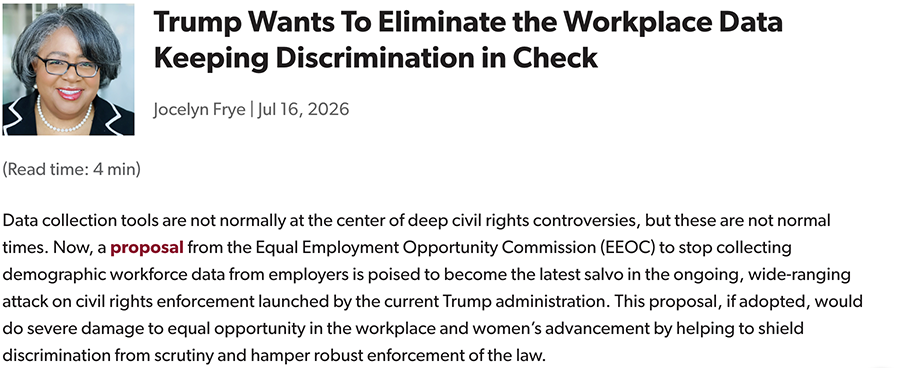
For more than 60 years, the EEOC has used the EEO-1 form, more formally known as the Employer Information Report, to collect demographic data on an annual basis about the workforce composition of employers with 100 or more employees. The form requires an employer to provide the number of employees in its workforce across ten job categories, and those data must be broken down by race, gender, and ethnicity. When collected, the data help provide insight into where workers fall within an organization and areas of concentration for different groups of workers across industries, pinpointing disparities and shedding light on broader employment trends.
We respect your privacy. Read our policy.
Note: The information contained in this publication reflects media coverage of women’s health issues and does not necessarily reflect the views of the National Partnership for Women & Families.