
Senators Clash Over Whether Parents or Politicians Should Decide on Trans Youth Care
Advocate, June 3, 2026
A Senate hearing on gender-affirming care for minors on Wednesday became a fight over who gets to make decisions for transgender children, whether politicians should override doctors and parents, and whether the Trump administration’s escalating campaign against gender-affirming care is rooted in concern for children or hostility toward transgender people … Shannon Minter, the legal director of the National Center for LGBTQ Rights said Democratic Senators, “[D]id a really good job of contextualizing today in the context of this administration’s larger attack on transgender people[.] They made it so clear that this is not a genuine concern about healthcare, that it’s part of a larger pattern of dehumanizing and harassing a vulnerable minority group.”

Banning Transgender Athletes Has Never Been About Protecting Women
The Hill, June 4, 2026
The power politicians have over women’s bodies is one of the oldest tools of control in American history. Throughout that history, the promise of protecting women has been the longtime excuse for excluding women from civic life and limiting our freedom. That history isn’t over. The Supreme Court will soon decide Little v. Hecox and West Virginia v. BPJ – legal cases out of Idaho and West Virginia that will determine whether transgender athletes will be allowed to compete on women’s and girls’ school sports teams … Today, as the defense teams in Hecox and BPJ seek to police the bodies of transgender women and girls, all women and girls who don’t adhere to society’s rigid standard of femininity will feel the impact.
State Lawmakers Laud Passage of Bills Protecting Reproductive, Gender-Affirming Care
WBEZ Chicago, June 2, 2026
The Illinois legislature’s spring session ended with it signing off on a series of measures setting up protections for LGBTQ+ people, trans foster youth and those seeking abortions – though progressive lawmakers are still looking ahead at where gaps may lie in state law. The legislation removes hormone and abortion medications from the state’s prescription monitoring program, require insurers licensed in Illinois to cover at least six months of hormone prescriptions by 2028, and creates a framework for youth in foster care to have a say when they are being moved out of state.
Families Fight the Trump Administration’s Effort To Obtain Their Children’s Private Medical Records
Advocate, June 3, 2026
Since January, candidates have spent almost four times less on campaign ads about abortion, compared to the same period in 2024. It underscores a broader shift in attention within the party ahead of the midterm elections this fall, as voters consistently rank cost-of-living concerns as their top issue, raising questions about what an evolving Democratic message on reproductive rights looks like in 2026. Abortion-rights advocates acknowledge it’s been a challenge to break through on messaging this year, citing a crowded news cycle, but argue that calls to protect reproductive access and care need to be part of the political conversation around affordability.
Attacks on Abortion and Gender-Affirming Care Are Inextricably Linked
Advocate, April 7, 2026
The Supreme Court’s recent ruling to preserve access to telehealth abortions has escalated anti-abortion activists’ frustrations with the Trump administration and ramped up the groups’ pressure campaign directed at the White House. With the high court unwilling for now to curb the availability of drugs used in more than two-thirds of abortions, abortion opponents are demanding that the federal agencies President Donald Trump oversees take immediate action or risk depressing conservative turnout in the upcoming midterm elections.
ICYMI: In Case You Missed It
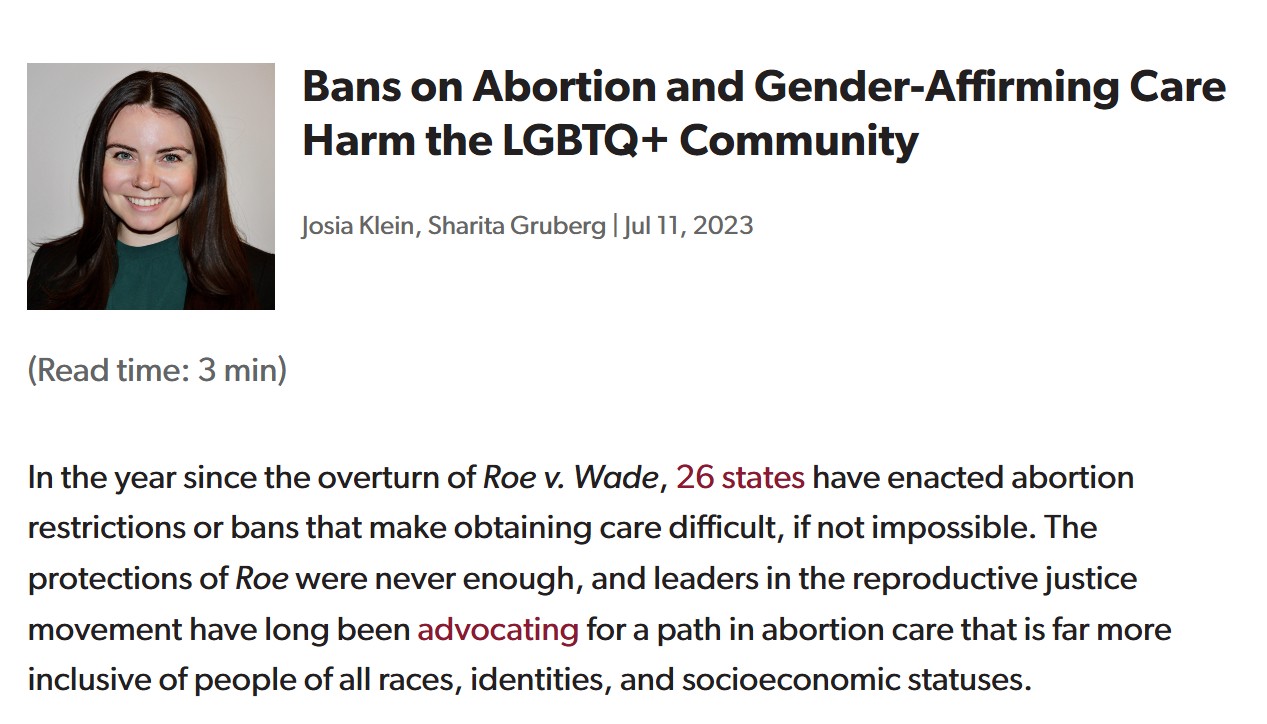
It is essential that the framework for abortion equity centers LGBTQ+ people, who experience both structural and interpersonal discrimination in settings including health care, employment, and the public sphere
We respect your privacy. Read our policy.
Note: The information contained in this publication reflects media coverage of women’s health issues and does not necessarily reflect the views of the National Partnership for Women & Families.