

Listening to Mothers is more than a survey. It is the National Partnership for Women & Families' flagship vehicle for translating women's lived experiences into policies that improve maternity care, advance equity, and strengthen the health and well-being of women, infants, and families.
Guided by the top concerns expressed by mothers themselves, we identified six interconnected priority action areas for system transformation and translated them into specific goals for each priority area. Together, these serve as the unified vision across systems for policymakers, industry leaders, health systems and providers, professional organizations, and community partners for what a maternity care system that centers women looks like.
Mothers have told us clearly what needs to be fixed, and which positive experiences are worth scaling and building on. It’s time to listen to mothers and act accordingly to:
- Guarantee respectful, holistic, culturally safe care for every mother, every birth, every time.
- Build, strengthen, and support the diverse workforce every mother needs.
- Combat the maternal mental health crisis through integrated, culturally responsive systems of care.
- Strengthen accountability for high-quality, evidence-based maternity care.
- Expand and protect affordable, comprehensive health coverage.
- Address the social, economic, and environmental conditions that shape maternal and infant health.
 40%
40%of mothers reported not feeling heard or listened to by providers
 “I was yelled at to shut up and told nobody needs to make noise during labor.”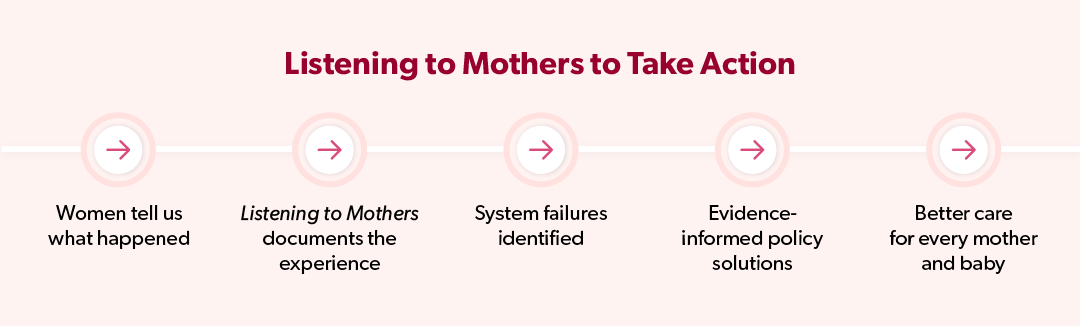
Related Resources
Survey QuestionnairesSocial Media Toolkit
Summary
System Transformation Priority Action Areas
The findings in this report reveal recurring patterns rather than isolated events that demand systemic solutions. Women describe challenges obtaining respectful care, participating in decisions, accessing behavioral health services, finding providers, maintaining insurance coverage, navigating fragmented systems, and balancing pregnancy and early parenthood with work, caregiving, and financial pressures. These are not individual failures – they are indicators of structural barriers that require structural solutions.
Guided by the top concerns expressed by mothers themselves, we identified six interconnected priority action areas for system transformation and translated them into specific goals for each priority area. Together, these serve as the unified vision across systems for policymakers, industry leaders, health systems and providers, professional organizations, and community partners for what a maternity care system that centers women looks like.
These priorities are intentionally interconnected. Respectful care depends on a well-supported workforce. High-quality care requires meaningful accountability. Coverage must translate into timely access to services. Mental health cannot be separated from maternity care, and health care alone cannot overcome the effects of poverty, unstable housing, food insecurity, transportation barriers, or inadequate paid leave. Women do not experience these challenges in isolation, and neither should the policies designed to address them.
The system transformation priorities that follow are grounded in a simple but powerful principle: A maternity care system cannot be considered high quality unless it listens to women, respects their choices, responds to their needs, and is accountable for their experiences and outcomes.
PRIORITY 1
Guarantee respectful, holistic, culturally safe care for every mother, every birth, every time.
Respectful, person-centered maternity care is the foundation of safe, high-quality care – not an optional feature. Every childbearing family deserves care that honors their dignity, autonomy, and lived experience. When women are ignored, coerced, discriminated against, or denied meaningful participation in decisions about their care, these are not simply poor patient experiences, they are failures of quality and patient safety.
LTM IV respondents repeatedly described not feeling heard, respected, or safe. These experiences were particularly pronounced among Black women, Indigenous women, and other historically marginalized communities, who continue to experience higher rates of discrimination, mistreatment, and preventable harm. Respectful maternity care is both a quality imperative and a birth equity imperative.
Systems Transformation Goals
- Make respectful maternity care a core patient safety and quality standard.
- Measure, report, and act on women’s experiences.
- Build a maternity care workforce equipped to deliver culturally safe, trauma-informed care.
- Protect bodily autonomy, civil rights, and shared decision-making.
- Create systems that respond when women raise concerns.
- Hold institutions accountable for delivering respectful care.
What accountability looks like: Every woman is treated with dignity, listened to without bias or judgment, actively involved in decisions about her care, and protected from discrimination, coercion, and preventable harm throughout pregnancy, birth, and the postpartum period.
PRIORITY 2
Build, strengthen and support the diverse workforce every mother needs to have a healthy and safe pregnancy, birthing and postpartum, including mental health, and specialized care for high-risk, complex care, and social supports.
Every childbearing family deserves access to a coordinated, interdisciplinary maternity care team that can meet their clinical, behavioral health, and social support needs throughout pregnancy, birth, and the postpartum period. Yet workforce shortages, maternity care deserts, hospital and maternity unit closures, and inadequate investment in community-based care continue to limit access to high-quality, culturally responsive, and risk-appropriate care.
LTM IV respondents consistently highlighted the value of midwives, doulas, lactation professionals, peer support workers, and culturally congruent providers while describing how difficult these supports were to access or afford. Building and sustaining a diverse, community-rooted workforce that spans the full continuum of maternity care is essential to improving outcomes and advancing equity.
Systems Transformation Goals
- Build the full continuum of the maternity care workforce.
- Redesign maternity care around interdisciplinary, risk-appropriate teams.
- Transform payment to support workforce sustainability.
- Rebuild maternity care infrastructure in underserved communities.
- Develop and sustain a workforce that reflects and is rooted in the communities it serves.
- Expand evidence-based models that improve outcomes.
What accountability looks like: Every family has timely access to a coordinated maternity care team that reflects their community, is fairly supported, and provides the right care, in the right setting, throughout pregnancy and the postpartum period.
PRIORITY 3
Combat the maternal mental health crisis through integrated, culturally responsive systems that ensure prevention, early identification, timely intervention, treatment, and sustained support across pregnancy and the postpartum year.
Maternal mental health is inseparable from maternal health. Mental health conditions are among the leading preventable causes of maternal mortality, yet too many women continue to experience depression, anxiety, trauma, emotional isolation, and substance use disorders without timely access to appropriate care. Particular attention should be given to addressing inequities in access to culturally responsive maternal mental health care experienced by Black, Indigenous, rural, immigrant, and other underserved communities.
LTM IV respondents described unmet mental health needs across pregnancy and the postpartum year, often facing fragmented systems, stigma, and barriers to treatment. Every woman deserves access to a maternal mental health system that promotes well-being, identifies needs early, provides timely treatment, and supports long-term recovery for mothers, infants, and families.
Systems Transformation Goals
- Build a comprehensive maternal mental health system.
- Fully integrate behavioral health into maternity care.
- Expand access to culturally responsive, community-based care.
- Address trauma and promote healing.
- Measure outcomes—not simply screening.
- Replace stigma and criminalization with compassionate care.
What accountability looks like: Every woman receives timely, culturally responsive mental health and substance use care that supports her well-being throughout pregnancy, postpartum, and beyond.
PRIORITY 4
Strengthen accountability for high-quality, evidence-based maternity care and reduce practices that undermine maternal and infant health.
Too many women receive maternity care shaped by institutional routines rather than evidence or their own informed preferences. LTM IV respondents described feeling pressured into interventions, receiving inadequate information, and experiencing care that too often prioritized convenience over evidence and partnership.
High-quality maternity care requires changing what the health care system measures, rewards, and expects.
Systems Transformation Goals
- Make evidence-based, person-centered care the standard.
- Increase transparency and public accountability.
- Transform payment to reward quality rather than procedures.
- Reduce unnecessary interventions through evidence-based guardrails.
- Expand access to evidence-based models of care.
- Create continuous learning and accountability systems.
What accountability looks like: Every woman receives evidence-based, respectful maternity care that is guided by science, informed by her preferences, and supported by payment and accountability systems that reward quality.
PRIORITY 5
Expand and protect affordable, comprehensive health coverage, including Medicaid, that allows every family to access the care they need, where and when they need it.
Health coverage should guarantee access to care – not create barriers to it. Every family deserves affordable, comprehensive coverage that allows them to receive the services they need, from the providers they choose, throughout pregnancy and the postpartum year.
LTM IV respondents repeatedly described insurance barriers, difficulty finding providers who accepted Medicaid, and financial obstacles that delayed or prevented care. Coverage must support reproductive justice by ensuring every family can access whole-person maternity care, regardless of income, geography, or immigration status.
Systems Transformation Goals
- Protect and strengthen Medicaid as the foundation of maternal health coverage.
- Ensure comprehensive, whole-person benefits.
- Expand access to the providers and settings families choose.
- Remove barriers that limit meaningful access to care.
- Advance equitable access for historically excluded communities.
- Measure access by whether women receive care – not simply whether they have insurance.
What accountability looks like: Every family has continuous, affordable coverage that provides timely access to the full range of maternity, reproductive, behavioral health, and supportive services they need.
PRIORITY 6
Support birthing families by addressing their health-related social and economic needs.
Healthy pregnancies and healthy families require more than high-quality medical care. Economic security is maternal health policy. Safe housing, paid family and medical leave, nutritious food, transportation, affordable child care, healthy workplaces, and strong communities all shape maternal and infant health and are among the strongest predictors of whether families can thrive before, during, and after pregnancy.
LTM IV respondents described the daily realities of navigating pregnancy while facing housing instability, food insecurity, transportation barriers, employment pressures, child care challenges, financial stress, and environmental risks. Their experiences make clear that health care alone cannot overcome the structural conditions that undermine maternal health. Improving maternal health requires a maternity care system that recognizes these realities, partners across sectors to address them, and invests in the social and economic conditions that allow every family to thrive.
Systems Transformation Goals
- Recognize health-related social and economic needs as an essential part of maternity care.
- Establish paid family and medical leave as a foundational maternal health policy.
- Build coordinated systems that connect families to meaningful support.
- Invest in community organizations as essential partners in maternal health.
- Strengthen the economic and environmental conditions that allow families to thrive.
- Create shared accountability across sectors for maternal and family well-being.
What accountability looks like: Every family has the economic security, including comprehensive paid family and medical leave, the community supports, and the healthy living conditions needed to experience a healthy pregnancy, recover after childbirth, bond with their infant, and thrive throughout the critical first year postpartum.