EXPLAINER | This explainer lays out what federal contractors, civil rights organizations, and others need to know about the March 26, 2026 Executive Order and its impact on the current legal landscape.

EXPLAINER | This explainer lays out what federal contractors, civil rights organizations, and others need to know about the March 26, 2026 Executive Order and its impact on the current legal landscape.
REPORT| Nearly 36 million workers – mostly women – telework at least some hours. We analyze who is and isn't teleworking and propose new policies to thoughtfully implement work from home opportunities.
ISSUE BRIEF | This brief reviews existing research on the impact of Artificial intelligence (AI) for women workers and provides new data on how women workers are overrepresented in occupations where they may be particularly affected by AI in the workplace.
FACT SHEET | A look at the wage gap for Asian American, Native Hawaiian and Pacific Islander women by ethnic subgroup, and what that gap means for them and their families.
ISSUE BRIEF | More than 6.1 million Black women – 57% of Black women in the labor force nationwide – live in 18 states that fail to guarantee workers paid sick days and also block local governments from setting their own paid leave standards (known as "preemption").
EXPLAINER | Collecting workforce demographic data at the federal level plays an important role in enforcing federal laws prohibiting job discrimination. This explainer provides an overview of the EEO-1 data collection and its uses.
FACT SHEET | Even in states with large populations of Black women in the workforce, rampant wage disparities persist, with potentially devastating consequences for Black women and families.
FACT SHEET | Black mothers of young children are facing the steepest declines in labor force participation in recent years. The declines are particularly dramatic for college-educated Black mothers – and they have been most pronounced in recent months.
FACT SHEET | Women of color in the United States experience the nation's persistent and pervasive gender wage gap most severely. U.S. Census Bureau data reveal the size of that gap by race.
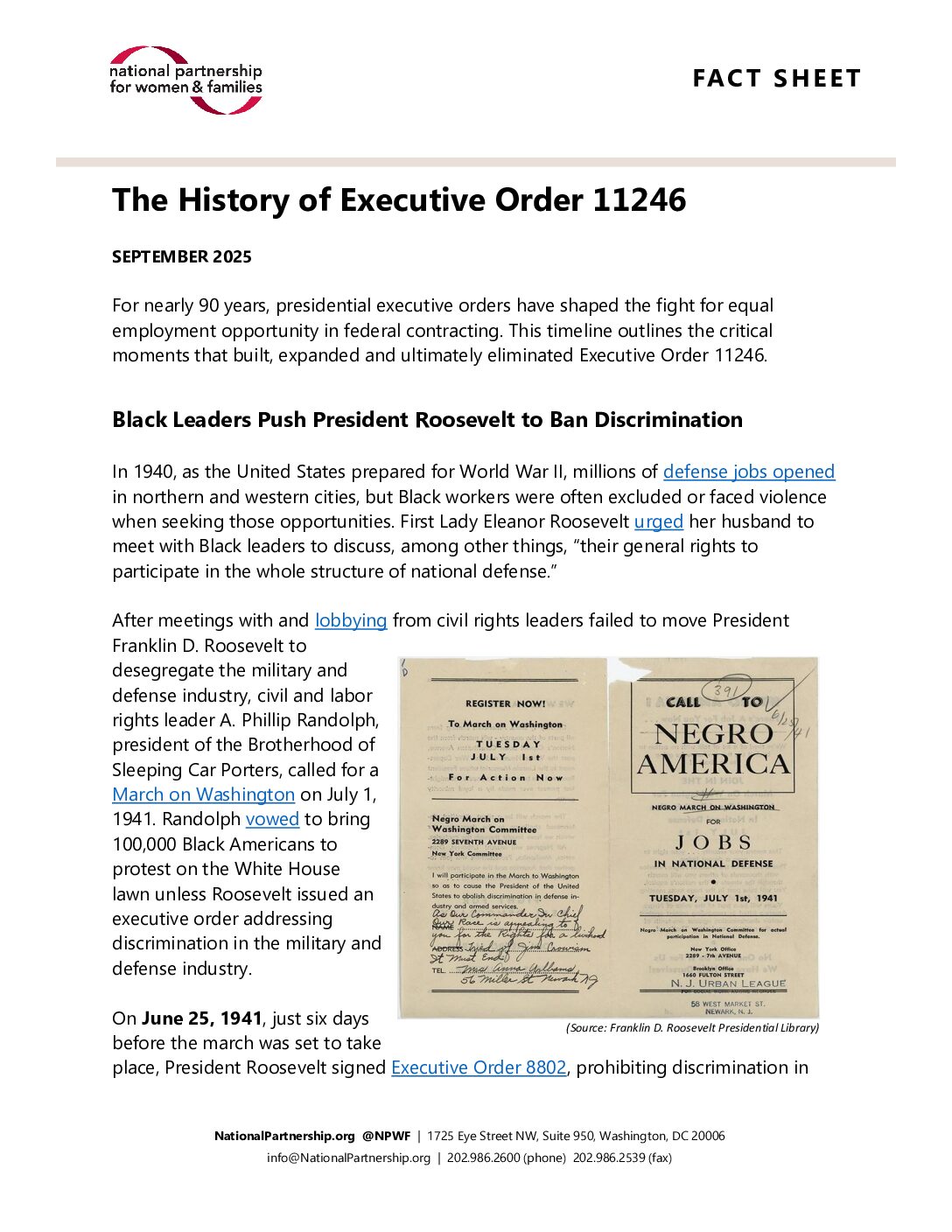
FACT SHEET | For nearly 90 years, presidential executive orders have shaped the fight for equal employment opportunity in federal contracting. This timeline outlines the critical moments that built, expanded and ultimately eliminated Executive Order 11246.
FACT SHEET | The EEOC has recovered billions for workers who have suffered discrimination. From 2014-2024, the EEOC recovered $5.6 billion for workers who were discriminated against.
FACT SHEET | Federal employees provide essential services to people – and when they are under threat, so too is that important work. It would also impact the economy overall. Costing hundreds of thousands of workers – or more – their jobs could dramatically spike...
ISSUE BRIEF | Black women are family caregivers – and they need flexibility and economic supports to make the best decisions for themselves and their families
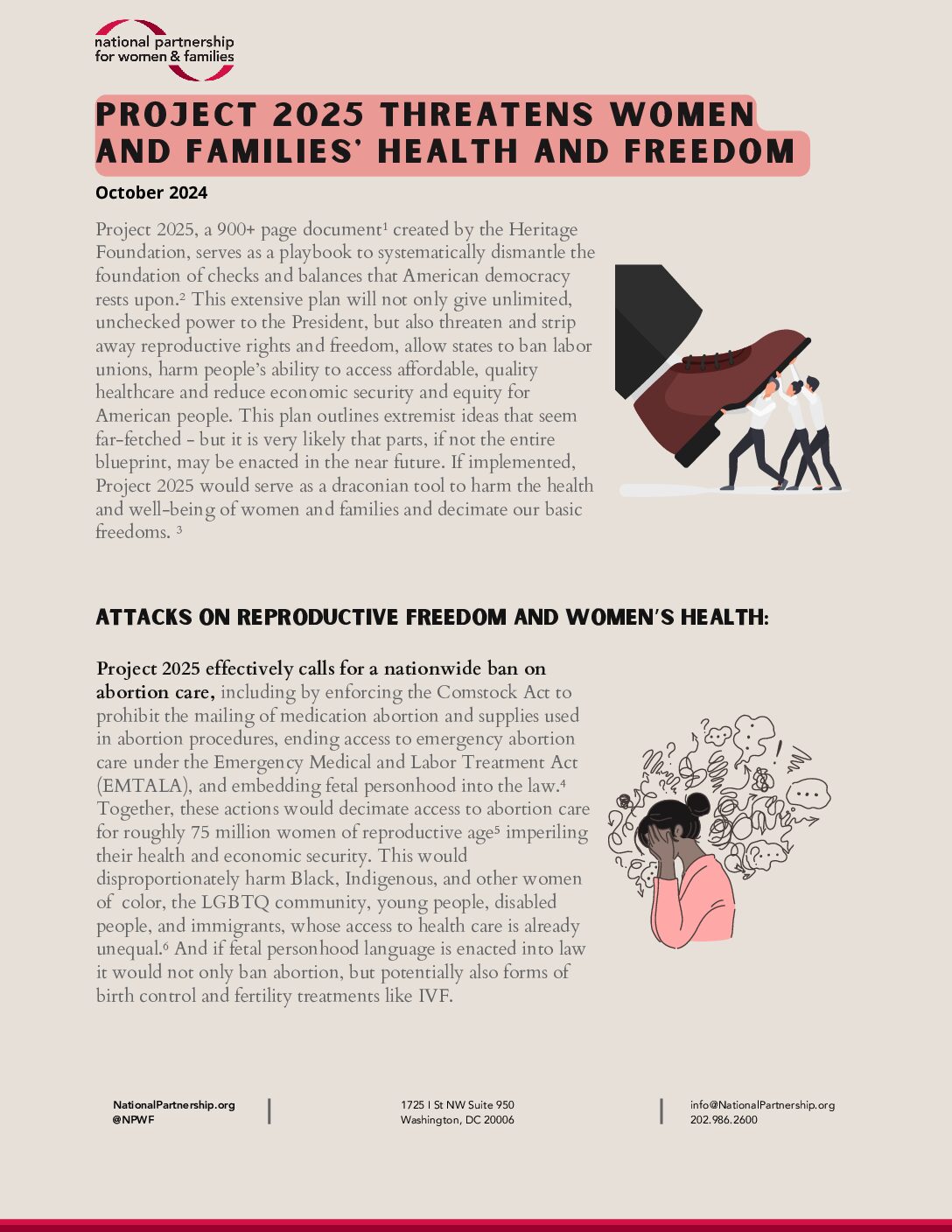
INFOGRAPHIC | Project 2025, a 900+ page document created by the Heritage Foundation, serves as a playbook to systematically dismantle the foundation of checks and balances that American democracy rests upon. If implemented, Project 2025 would serve as a draconian tool...
In the November 2024 election, abortion access will be on the ballot in 10 states. Our analysis shows that more than 16.5 million women of reproductive age – 21.9 percent of all women of reproductive age in the U.S. – could be impacted by changes to...
REPORT | The first report in this series discussed barriers that disabled women face in obtaining and maintaining employment. Many of these barriers are exacerbated by a lack of safe, stable, accessible and affordable housing and transportation.
REPORT | The reproductive health of Black women has long been compromised by interpersonal, institutional, and structural racism. In addition to contending with social and economic drivers of poor health that undermine Black Americans, they have experienced...
Everyone should be able to weather a financial shock -- a major illness, a layoff -- without losing their housing or falling deep into debt. Everyone should be able to afford educational opportunities for themselves or their children and be able to retire with dignity...
Systemic racism is a fundamental, multilevel driver of pervasive health inequities in the United States. Racism threatens our nation’s health so deeply that the American Medical Association, the American Public Health Association, and a growing list of U.S. cities,...