
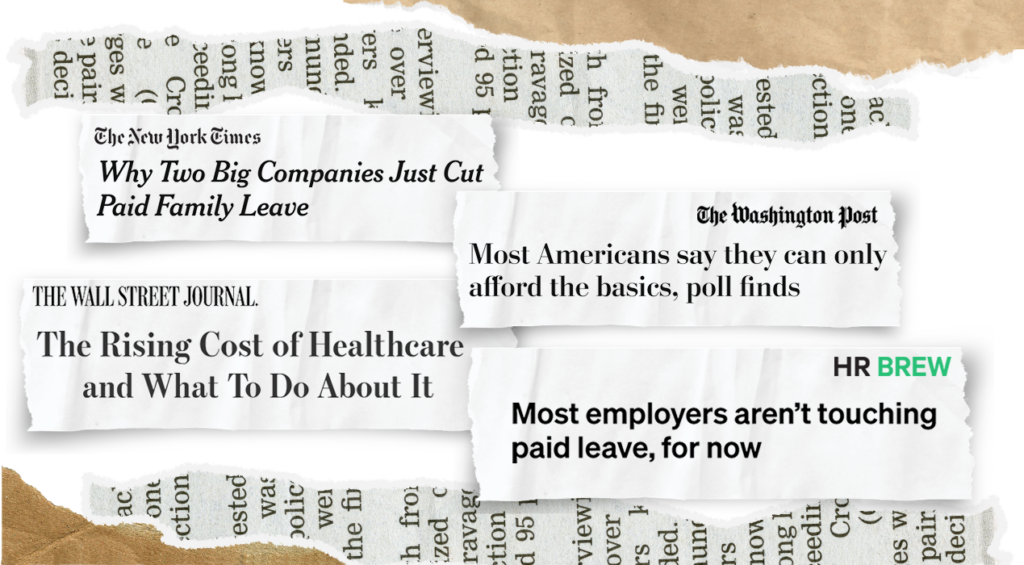
The erosion of employer-sponsored benefits and the gutting of public health coverage aren’t two separate stories. They’re one story – a double squeeze that’s quietly hitting workers in the U.S. from both sides simultaneously.
On one side, employers are cutting benefits: paid leave, fertility coverage, mental health benefits, retirement contributions, and health plan quality. On the other, the federal government is dismantling the public coverage that workers fall back on when employer benefits aren’t enough – or don’t exist. That last point matters: 73 percent of workers in this country – over 100 million people – don’t have access to paid leave through their employer.
Workers rarely experience these changes at once. They find them in open enrollment packets that look a little worse than last year’s. Sometimes not until they actually need the benefit that it’s no longer there. There is no announcement, press release, or public accounting of what’s been lost.
Much of the conversation around the One Big Beautiful Bill Act (OBBBA) has focused on the over 14 million Americans projected to lose health insurance coverage directly. But the law’s reach doesn’t stop there. The ripple effects on employer-sponsored coverage – through cost shifts, hospital financial pressure and a hollowing out of the provider network – are significant, measurable and already underway.
The Structural Problem
American workers are caught between a rock and a hard place. From one side, employers are reducing benefits – incrementally, without announcement – driven by cost pressures and a labor market that has shifted, empowering companies enough to make those reductions feel less risky. Companies have acknowledged that increasing health care costs are forcing changes to their benefit plans. At the same time, the federal government is cutting the public programs workers rely on when employer coverage falls short.
Cost pressure is real. But it is the product of a health care system that repeatedly shifts costs rather than addressing the underlying challenges of affordability and access. That cost-pressure argument is harder to square against the numbers. Corporate profits are at record highs and median pay among the 100 highest-paid CEOs climbed nearly 36 percent in a single year.
Many of the institutional pressures that once encouraged employers to invest in workers – from competition for talent to environmental, social and governance (ESG) commitments and diversity, equity, and inclusion initiatives – have weakened or become politically contentious. As those pressures retreat, benefit reductions become easier to justify and easier to implement – not because companies can’t afford to invest in workers, but because fewer forces are compelling them to. Cuts presented as economic necessity are, for many employers, also choices.
This isn’t simply a collision of economic and political forces. It’s the predictable result of how the United States has chosen to structure its social safety net.
Unlike most wealthy nations, the U.S. relies heavily on employers to provide benefits that elsewhere are treated as public infrastructure: health care, paid family and medical leave, retirement security, and many caregiving supports. That arrangement has always been fragile.
Employer-sponsored benefits are inherently cyclical. When employers compete aggressively for workers, benefits expand. When hiring slows or economic uncertainty rises, those same benefits become among the easiest expenses to reduce. Workers’ access to essential supports rises and falls with business conditions rather than with human need.
For decades, public programs helped cushion some of that volatility. Workers who lost employer coverage or couldn’t access certain benefits still had Medicaid, Affordable Care Act marketplaces, or other supports to fall back on. The backstop was never complete, but it prevented many workers from bearing the full cost when employer coverage fell short.
What makes this moment different is that both pillars of the system are weakening at the same time. Employers are retreating from benefits just as the federal government is retreating from the programs workers rely on. The result isn’t simply fewer benefits. It is a system with fewer places left to absorb the shock.
The consequences are not hypothetical – they’re economic. When workers are paying more for health care, they have less money to spend on everything else. When caregivers – still disproportionately women – leave the workforce because they lack paid leave or affordable care, labor force participation falls and employers lose experienced workers. Hospital closures increase travel times, delay care and create new barriers to accessing care.
All of it is happening in an economy where health care already accounts for nearly one in every five dollars spent and health care costs are projected to outpace economic growth every single year for the next decade. Yet despite spending more on health care than any other nation, the United States continues to lag many of its peers on key health outcomes.
The workers most exposed are the employee whose benefits got quietly restructured, the rural family whose nearest hospital just announced it is closing its labor and delivery unit, and the person who planned their family around an IVF benefit that has now been eliminated.
The Federal Multiplier
The One Big Beautiful Bill Act (OBBBA) doesn’t just reduce access to health coverage – it amplifies the structural weaknesses already built into America’s employer-based system.
On July 4, 2025 – with a symbolism that was surely not accidental – the OBBBA was signed into law. The legislation includes approximately $1.15 trillion in federal health care cuts over the next decade and is projected to leave more than 14 million Americans without health insurance. But the story doesn’t end with those who lose coverage directly.
The law doesn’t simply reduce spending. It redirects costs.
Low-wage workers who lose Medicaid or Affordable Care Act coverage do not disappear from the health care system. Their health care needs do not disappear either. Many will transition into employer-sponsored insurance; others will become uninsured and seek care only when conditions become acute. Either way, the costs don’t vanish. They shift.
Hospitals absorb more uncompensated care. Commercial insurers negotiate higher reimbursement rates to offset lost revenue. Employers face higher premiums. Workers pay more through payroll deductions, deductibles and out-of-pocket costs. What begins as a federal budget cut ultimately shows up in family budgets and employer balance sheets.
The impact falls hardest on women. Medicaid is the single largest payer of maternity care in the U.S. – covering over 40 percent of births nationwide and nearly half of all births in rural communities. Our research found that 131 rural hospitals with labor and delivery units are now at risk of closure or severe service cutbacks as a direct result of HR1’s Medicaid cuts.
The risks are already materializing. As of April 2026, four of the rural labor and delivery units identified in our original analysis have already closed, along with ten additional rural units that were not included in that assessment. Across the country, 32 labor and delivery units have closed since passage of the OBBBA. When those units close, pregnant patients travel further for care, delay treatment and face greater risk of adverse outcomes – exacerbating a maternal health crisis that was already severe.
The effects extend well beyond maternity care. Hospitals that remain open will still face mounting uncompensated care costs. To recover lost revenue, they’ll seek higher reimbursement from commercial insurers and those higher prices flow back into premiums. Industry analysts consulted by the AFL-CIO estimated that 179 million people with employer-based coverage could see annual cost increases of $182 to $485.
This is how the American health care system works. When public coverage shrinks, costs move through the system until they reach employers, workers, and families who were never the intended targets of the original policy.
The question, then, is not whether we pay for care. It is whether we continue paying for failure after the fact – or invest in policies that prevent those costs in the first place.
These Aren’t Perks
For years, policymakers and employers have treated supports like paid leave, fertility coverage, mental health care and caregiving assistance as optional benefits – as enhancements to be offered when budgets allow and trimmed when they don’t.
That framing has always been misleading. Today, it is becoming increasingly expensive.
Paid leave isn’t a perk. It’s what allows a mother to recover from childbirth without losing her job. It’s what keeps a family from financial ruin when a parent is diagnosed with cancer. It’s the difference between a worker who can care for a dying parent and one who has to choose between their job and being present at the end of someone’s life.
Fertility coverage helps families grow. Mental health and caregiving supports often determine whether workers can remain healthy, productive, and attached to the labor force.
Americans consistently rank the cost of living as their top concern, and roughly two-thirds report cutting back on spending to keep up with rising costs. New research from Dayforce and the Living Wage Institute found that just over half of full-time workers – 50.7 percent – earn enough to cover their family’s basic needs. Among full-time hourly workers, that number falls to 30.3 percent.
Against that backdrop, the loss of a benefit is rarely absorbed as an inconvenience. It becomes a financial shock.
Our own research puts a number on that reality. Covering just 12 weeks of basic expenses while on unpaid leave costs a typical worker $7,588. Under the FAMILY Act, that same worker would receive $9,709 in benefits – enough to cover the bills and maintain financial stability during a period when earnings would otherwise disappear.
The costs associated with caregiving, illness and childbirth exist whether policymakers acknowledge them or not. The question is who bears them.
When paid leave is unavailable, families absorb the costs through lost income, debt and workforce exits. When care needs go unmet, workers leave jobs, productivity falls and employers pay the price. The costs don’t disappear. They move.
The Only Plan That Reaches Everyone
The research on how to break this cycle has existed for years.
Investments in paid leave and caregiving increase women’s labor force participation, expand labor supply and help ease inflationary pressures on the economy. If women in the U.S. worked at the same levels as women in countries with stronger caregiving policies, the economy would add $775 billion in activity each year.
Economists have estimated that the child care crisis alone costs the U.S. economy $122 billion annually: $78 billion absorbed by families, $23 billion by employers, $21 billion in lost tax revenue.
Again, the costs don’t disappear. They move.
The business case is equally clear. Employers that implemented paid leave saw 4.6 percent greater revenue and 6.8 percent greater profit per full-time-equivalent employee.
Our research found that a national paid family and medical leave program would save at least $62.4 billion in health care costs over the next decade through fewer low-birthweight births, reduced infant hospitalizations, prevention of postpartum depression, and reduced nursing home utilization among older adults.
Paid leave isn’t just good for workers. It is health care cost containment.
Paid leave isn’t the only investment that pays for itself. U.S. employers lose an estimated $226 billion annually to absenteeism – roughly $1,695 per employee. Research consistently shows that every dollar invested in employee health returns $3.27 in health care savings and $2.73 in reduced absenteeism costs.
The companies that invest in their workforce prove that cuts are a choice, not an inevitability. Levi Strauss expanded paid leave during a workforce reduction. Starbucks doubled parental leave during a turnaround. Their decisions show that even during periods of financial pressure, investment in workers remains possible.
But most workers don’t have the luxury of working for one of the exceptions.
What’s needed is a policy infrastructure that doesn’t depend on which company someone works for, whether that employer is competing aggressively for talent, or whether it happens to be having a good quarter.
That means a national paid family and medical leave program that covers every worker. It means protecting and expanding Medicaid as the backbone of health coverage. It means ACA subsidies that don’t expire based on the political winds. It means treating accessible, affordable health care not as a market commodity but as the public infrastructure it has always been.
What’s needed – in HR departments, in boardrooms, in Congress – is a reckoning with the fact that paid leave, caregiving support, and accessible health care are not line items to optimize. They are the infrastructure that holds working families and our economy together.
The central lesson is not that employers should be more generous. It is that essential protections should not depend on employer generosity in the first place.
Voluntary employer action has never been a reliable foundation for a safety net. Workers are not asking for generosity. They are asking for a system – public and employer-based – that does not fail from both directions at the moment they need it most.